What Do 13mm and 10mm Drivers Mean in Earbuds & Headphones?
When buying earbuds or headphones, you often see specifications like 10mm driver, 12mm driver, or 13mm driver listed in the product description. For many people, this number looks technical and confusing. Does a bigger driver really mean better sound? Or is it just a marketing term used by manufacturers?
In simple words, the driver is the tiny speaker inside your earbuds or headphones. The number (such as 10mm or 13mm) refers to the diameter of that speaker driver. This measurement can affect bass response, soundstage, and overall audio performance.
But driver size is only one part of the sound quality puzzle. Many other factors such as tuning, materials, and acoustic design also play an important role.
In this guide, we will explain what 13mm and 10mm drivers mean, how they affect sound quality, and whether they actually matter when buying earbuds or headphones.
What Is a Driver in Earbuds and Headphones?
Understanding the Driver
A driver is the core component responsible for producing sound. It converts electrical signals from your phone or music player into audible sound waves.
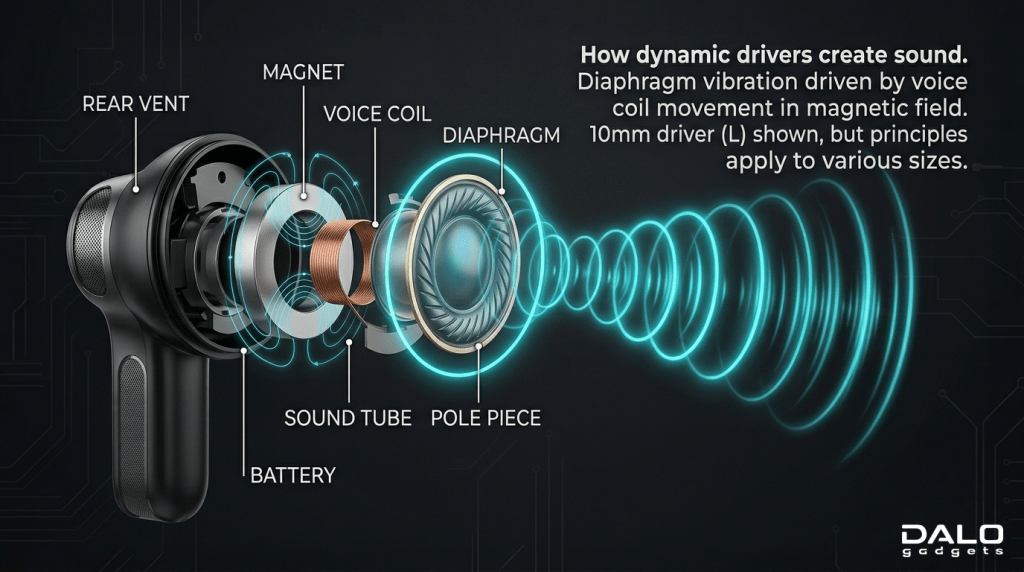
Most earbuds and headphones use dynamic drivers, which work using three main parts:
- Magnet
- Voice coil
- Diaphragm
When electrical signals pass through the voice coil, it moves within a magnetic field and vibrates the diaphragm. These vibrations create sound waves that reach your ears.
What Does 10mm or 13mm Mean?
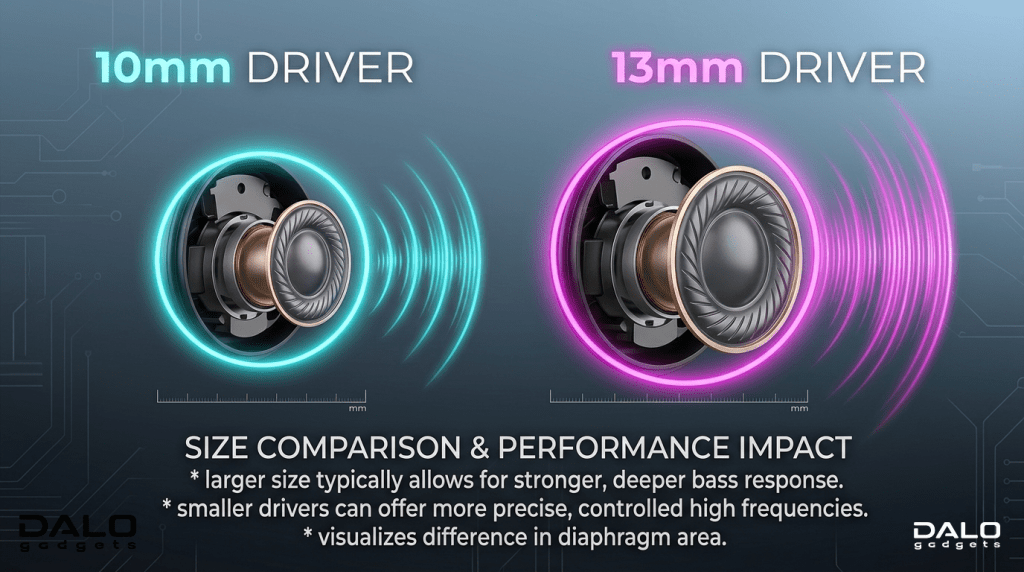
The number represents the diameter of the driver diaphragm, measured in millimeters.
For example:
- 10mm driver = 10 millimeter diameter speaker
- 13mm driver = 13 millimeter diameter speaker
Generally:
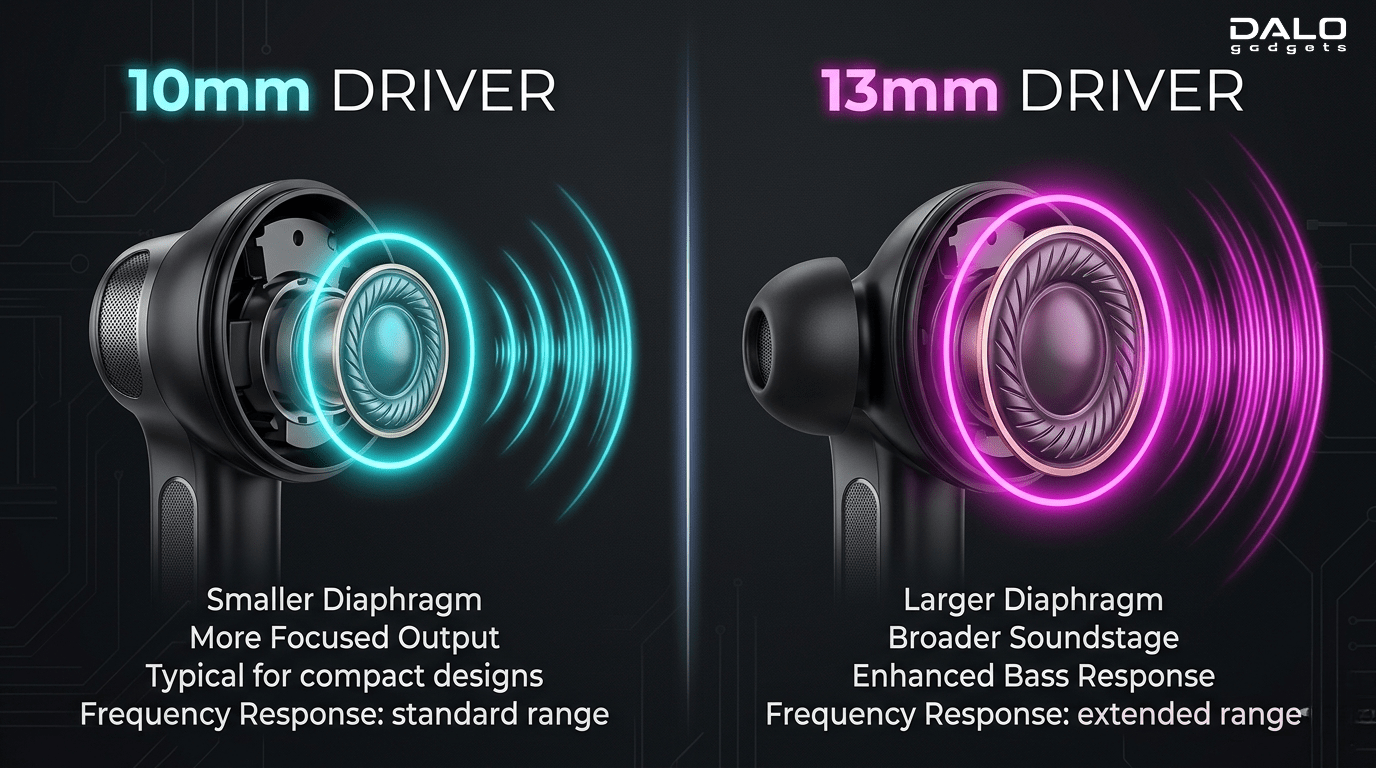
- Larger drivers (13mm+) produce stronger bass and wider sound.
- Smaller drivers (6-10mm) can offer better control and clarity.
However, bigger does not always mean better.
History and Background of Earbud Drivers
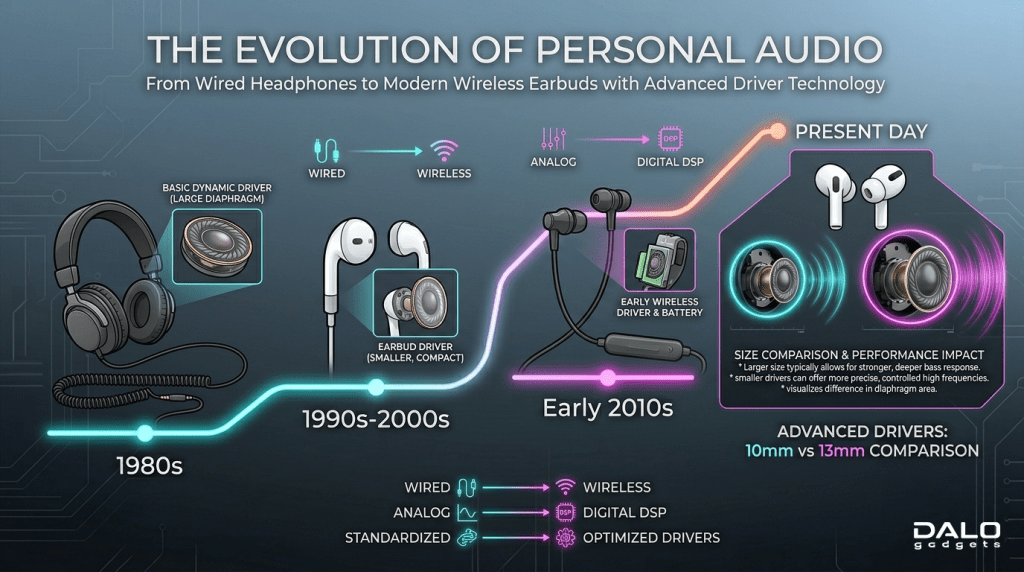
Early portable headphones in the 1980s and 1990s were quite simple. They mainly used small dynamic drivers designed for cassette players and portable radios.
When smartphones became popular, manufacturers started improving audio technology in earbuds.
Some major improvements included:
- Better driver materials
- Advanced acoustic tuning
- Introduction of balanced armature drivers
- Hybrid driver systems
- Noise cancellation technology
Today, modern earbuds from brands like Sony, Apple, Samsung, and JBL use highly optimized drivers ranging from 6mm to 14mm, depending on the design.
Interestingly, driver size has increased in many modern wireless earbuds, especially in budget and mid-range models, where brands use 10mm-13mm drivers to enhance bass performance.
Types of Drivers and Common Sizes
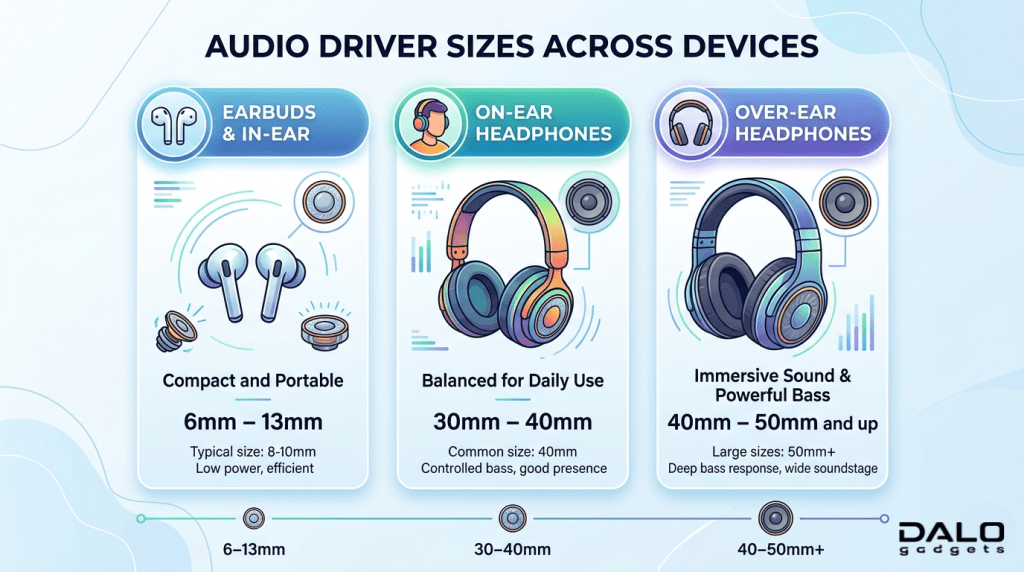
Driver size varies depending on the type of headphones or earbuds.
Common Driver Sizes
| Device Type | Typical Driver Size |
| True Wireless Earbuds | 6mm-13mm |
| Wired Earbuds | 10mm-15mm |
| On-ear Headphones | 30mm-40mm |
| Over-ear Headphones | 40mm-50mm |
For earbuds, 10mm and 13mm drivers are among the most common sizes today.
10mm Driver Earbuds
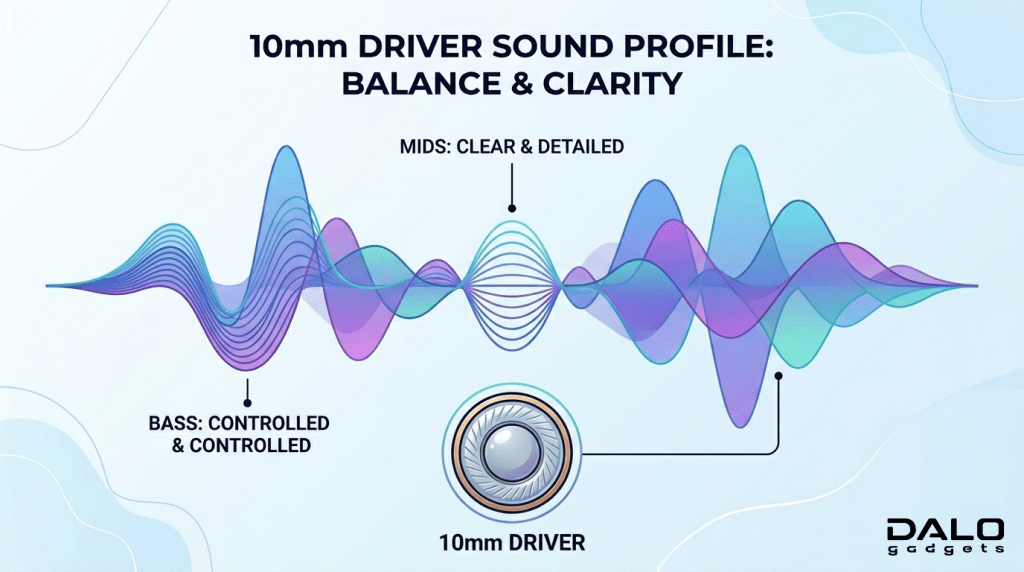
10mm drivers are considered balanced and efficient.
Sound Characteristics
- Balanced audio
- Controlled bass
- Clear mids
- Efficient power consumption
These are often used in premium earbuds where tuning is more important than raw power.
13mm Driver Earbuds
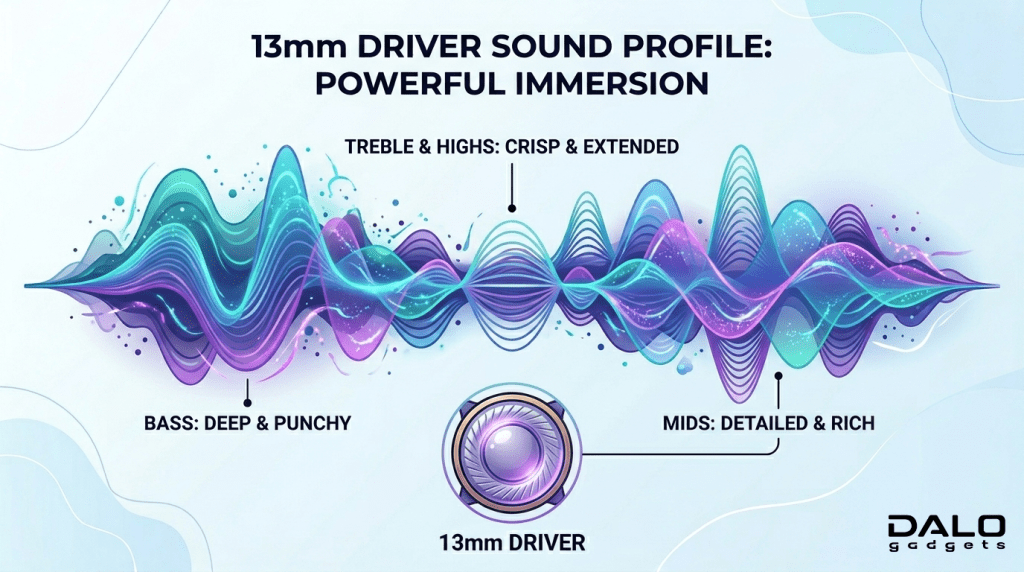
13mm drivers are larger and capable of producing more powerful sound waves.
Sound Characteristics
- Stronger bass
- Louder output
- Wider soundstage
- More immersive audio
However, if poorly tuned, they can sometimes produce boomy or muddy bass.
Other Driver Types Used in Earbuds
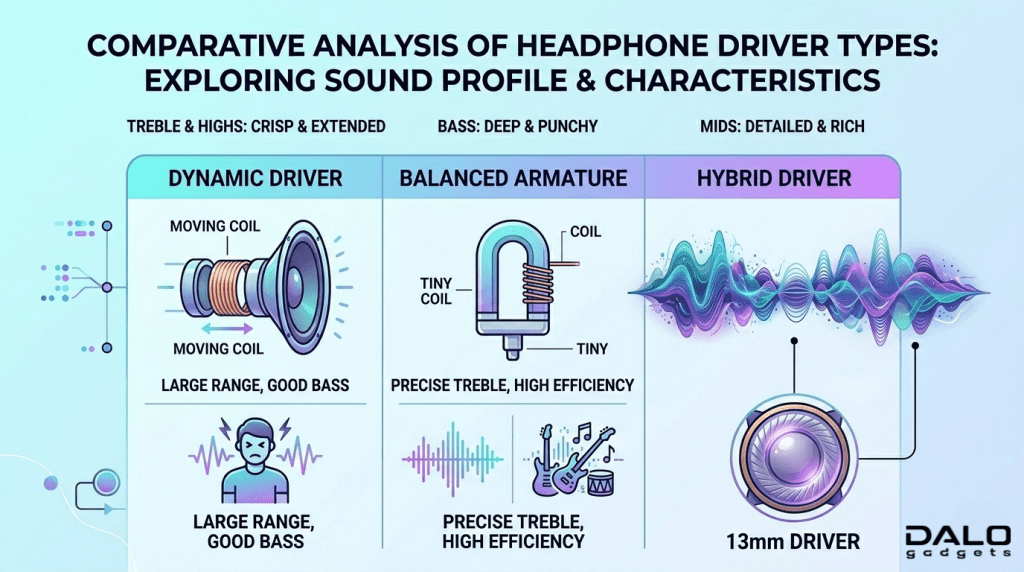
Besides driver size, different driver technologies exist:
Dynamic Drivers
Most common driver type used in earbuds.
Advantages:
- Affordable
- Strong bass
- Durable
Balanced Armature Drivers
Often used in professional in-ear monitors.
Advantages:
- Excellent detail
- Precise sound reproduction
Hybrid Drivers
Combination of dynamic + balanced armature drivers for better sound balance.
Why Driver Size Is Important
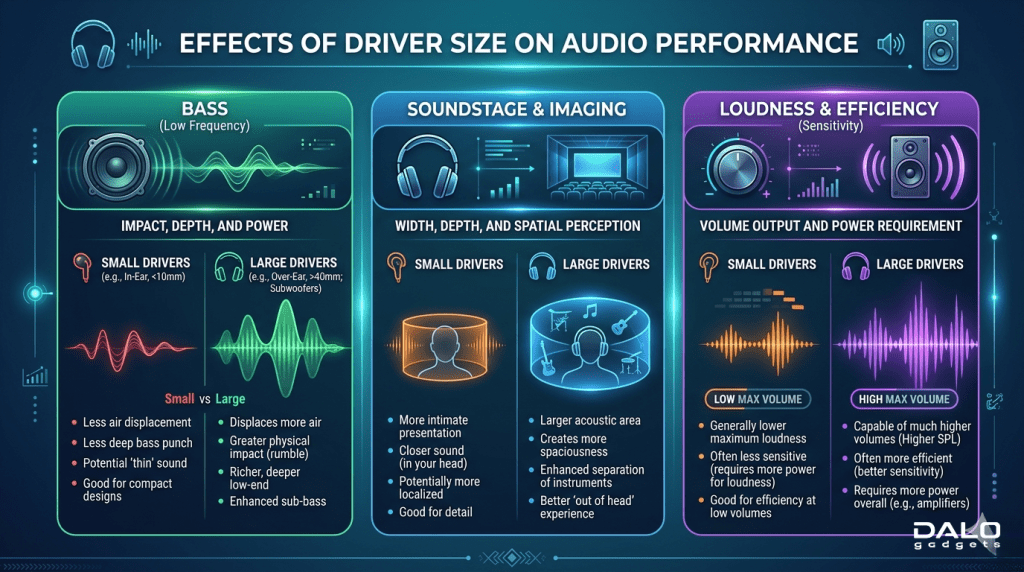
Many buyers assume bigger driver = better sound, but the truth is more complex.
Driver size affects several aspects of sound performance.
1. Bass Performance
Larger drivers move more air, which often results in:
- Deeper bass
- More powerful low frequencies
This is why many 13mm earbuds advertise “extra bass”.
2. Soundstage
Larger drivers can sometimes create a wider soundstage, making music feel more spacious.
This improves the experience when listening to:
- Movies
- Games
- Live recordings
3. Volume Capability
Larger drivers can generally produce higher sound pressure levels, meaning louder audio without distortion.
4. Power Efficiency
Smaller drivers such as 10mm drivers often consume less power, which can help improve battery life in wireless earbuds.
What You Should Know Before Buying

Driver size is important, but it should not be the only factor you consider when choosing earbuds.
Here are some things you should check before buying.
1. Look at Sound Tuning
Good sound quality depends heavily on how the driver is tuned, not just its size.
Some 10mm drivers can sound better than poorly tuned 13mm drivers.
2. Check Codec Support
Audio codecs like:
- SBC
- AAC
- LDAC
- aptX
also affect sound quality significantly.
3. Consider Noise Cancellation
Modern earbuds often include:
- Active Noise Cancellation (ANC)
- Environmental Noise Cancellation (ENC)
These features can improve listening experience more than driver size.
4. Read Reviews
Since you are planning a tech review blog, reading real-world reviews helps understand:
- Bass performance
- Vocal clarity
- Build quality
- Battery life
5. Comfort and Fit
Driver size does not guarantee comfort. Earbud design and ear tip fit are equally important.
Poor fit can reduce:
- Bass response
- Noise isolation
- Overall sound quality
Advantages of Larger Drivers (13mm)
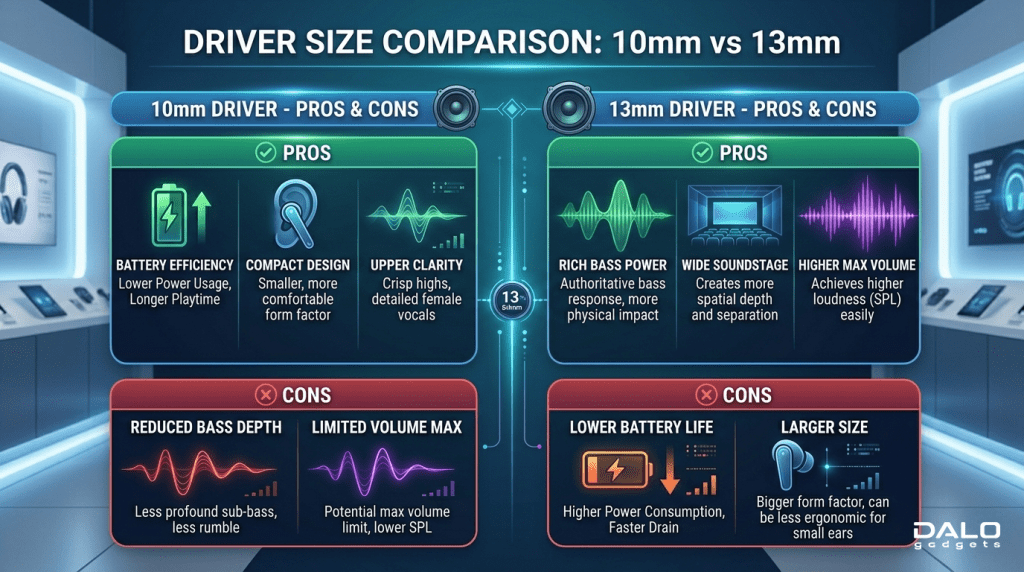
Pros
- Better bass performance
- Louder sound output
- Wider soundstage
- More immersive music experience
Cons
- Can cause bass distortion if poorly tuned
- May consume slightly more power
- Sometimes heavier earbuds design
Advantages of 10mm Drivers
Pros
- Balanced sound profile
- Better clarity in mids and vocals
- More efficient battery usage
- Often found in premium tuning designs
Cons
- Bass may feel slightly weaker
- Less powerful sound compared to larger drivers
Buying Guide: How to Choose the Right Driver Size
If you are shopping for earbuds, here is a simple guide.
Choose 13mm Drivers If You Want:
- Strong bass
- Loud sound
- Movie and gaming immersion
Choose 10mm Drivers If You Want:
- Balanced sound
- Better vocal clarity
- Longer battery efficiency
Also Check These Features
- Bluetooth version
- Noise cancellation
- Codec support
- Battery life
- Comfort and build quality
Conclusion: Do 13mm and 10mm Drivers Really Matter?
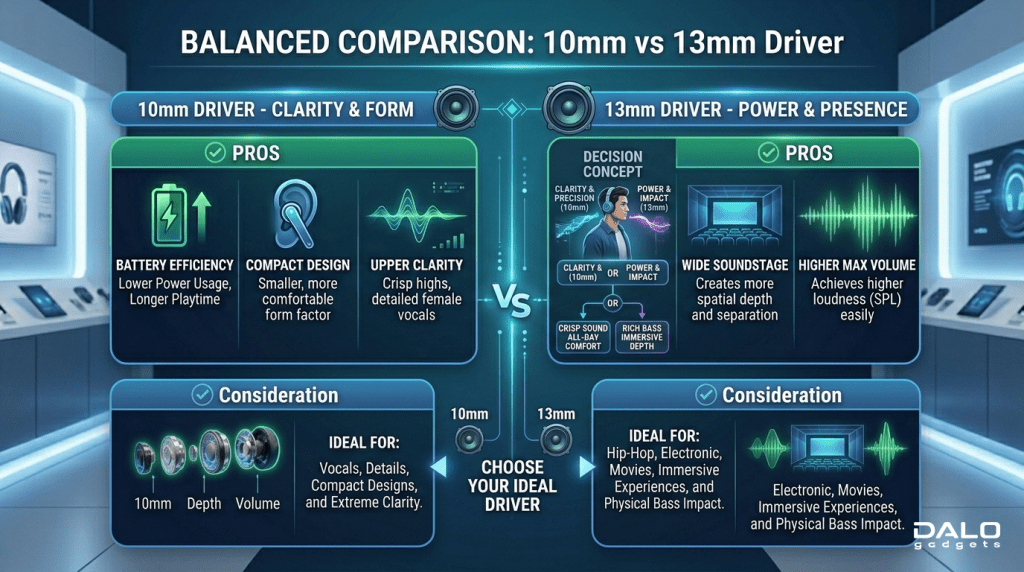
Driver size is an important specification when buying earbuds or headphones, but it should never be the only factor you consider.
A 13mm driver can deliver deeper bass and louder sound, while a 10mm driver often provides more balanced and controlled audio. However, sound quality depends heavily on driver tuning, acoustic design, and overall engineering.
For most users, the best approach is to look at the complete package:
- Driver technology
- Sound tuning
- Noise cancellation
- Codec support
- Comfort and fit
If you focus only on driver size, you might miss out on better-sounding earbuds.
In short, driver size matters, but good engineering matters even more.
Frequently Asked Questions (FAQ)
Are bigger drivers always better?
No. Larger drivers can produce stronger bass, but sound tuning and driver quality matter more than size alone.
Is 13mm driver better than 10mm driver?
Not necessarily. A well-tuned 10mm driver can outperform a poorly designed 13mm driver.
What driver size is best for earbuds?
Most high-quality earbuds use drivers between 8mm and 13mm, depending on the design.
Do headphones have bigger drivers than earbuds?
Yes. Headphones typically use 40mm to 50mm drivers, which produce a wider soundstage and deeper bass.
Does driver size affect battery life?
Indirectly. Larger drivers can require slightly more power, but modern earbuds optimize this with efficient chips.